


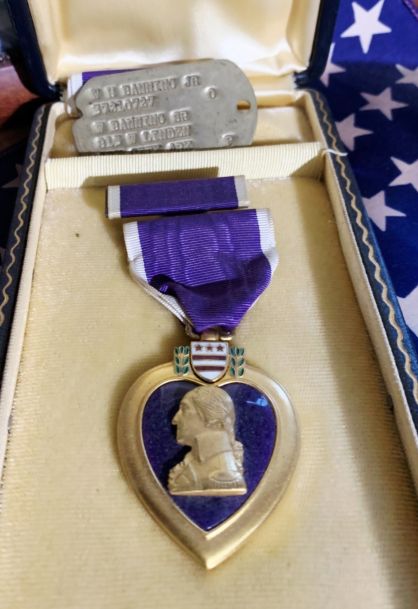
Walter H. Banning, Jr. — as much as we know about him.
Created by Major T. Frederick, the Devil’s Brigade was an elite World War II commando unit—the First Special Service Force (FSSF)—composed of U.S. and Canadian soldiers. The well-known 1968 film takes significant historical liberties, blending real missions with fictionalized characters and events for dramatic effect, though it does capture the spirit of this legendary unit known for its tough, cold-weather warfare. The unit was activated on July 9, 1942.
The unit’s motto was the German phrase “Das dicke Ende kommt noch!”, which translates to “The worst is yet to come!” This motto also served as a form of psychological warfare. FSSF soldiers carried cards bearing the unit insignia and motto and would leave them on dead German soldiers as a warning to their comrades.
The Devil’s Brigade fought during the 1944 landing at Anzio, the siege of Monte Cassino, and the invasion of southern France. The unit contributed to the capture of approximately 7,000 prisoners and inflicted an estimated 12,000 German casualties. They earned numerous citations and commendations and were known for being vicious, determined fighters. They put what was often described as “the fear of God” into the ranks of German soldiers as they fought their way through Italy and into southern France, leaving devastation in their wake.
There were several “waves” of fighters assigned to the Devil’s Brigade. The initial wave consisted of those trained and commissioned when the unit was first activated, followed by reinforcement waves as casualties mounted. Training continued after activation to replenish the ranks. Walter H. Banning became a member during the second wave of fighters assigned to the Brigade.
My name is Bruce Banning. I am the founder of Bucket List Dreams for Veterans, and Walter H. Banning was my uncle. To us, he was simply known as “Uncle Dub.”
Uncle Dub grew up in Arkansas City, Kansas, with my father and two sisters. Life was difficult, as they endured the hardships of the Great Depression. Survival required toughness, and Uncle Dub had plenty of it. He liked to fight and was often in trouble for beating up others. In many ways, he was a perfect fit for the Devil’s Brigade when he joined the Army.
We do not have many details about Uncle Dub’s military service, but we believe he demonstrated his willingness and ability during boot camp, which likely led to his selection for the Brigade. After completing Brigade training, he was immediately sent to Europe to join the fight.
We do not know exactly where or how long he fought with the Brigade, but during the brutal fighting at Anzio, Uncle Dub was severely wounded. As we understand it, he spent approximately a year in hospitals in Europe before being sent home and discharged, no longer able to fight.
The post-war years were difficult for Uncle Dub. He never married and lived alone. He became an alcoholic. I remember that, from time to time, my father would receive calls from their mother asking him to speak with Dub. My father seemed to have some influence over him—perhaps because they had both served in Europe—and was often able to calm him down. Uncle Dub had encounters with local law enforcement but never committed offenses that resulted in serious jail time.
When I was eight years old, our family made the long trip from Michigan to Kansas to visit our relatives. One of the most memorable parts of that trip was spending time with Uncle Dub. Years later, my mother told me that the family said it was the only week they could remember when Uncle Dub did not drink. He wanted to be with me and my brothers, and he clearly wanted to make a good impression.
I am convinced that Uncle Dub was a good man, much like my father. Sometimes, however, war takes so much from a person that recovery becomes impossible.
Uncle Dub died young. He never fully recovered from his injuries and suffered deeply, using alcohol to cope with his pain. He was not the first to do so, certainly not the only one, and sadly, he will not be the last.
Any way you look at it, Uncle Dub gave his life for his country. He fought hard—hard enough to be part of one of the most elite fighting forces the United States has ever known.
Bucket List Dreams was founded by a disabled Veteran who observed that military service can often impact ones quality of life.